



|
Quantity
|
Total
|
||
|
|
|||
|
|
|||
Drum filters for garden ponds, koi ponds and RAS systems
Choosing the right filter for a garden pond or koi pond has a huge impact on water quality, the enjoyment you get from the pond and the amount of time spent maintaining it. Most people start with a simple question: which garden pond filter should I choose? There are many pressure, barrel, flow-through and multi-chamber filters available on the market. They often look attractive, promising clean water and easy installation, but after a while many users notice the same problem: the filter requires increasingly frequent cleaning, the flow rate drops, and keeping the water clear becomes more difficult.
This does not always mean that the filter is faulty. Very often, the problem stems from the very principle behind conventional filtration. Contaminants are trapped inside the filter, accumulate in sponges, mats or other filter media, and over time restrict the water flow. The larger the tank, the more fish there are and the more intensively they are fed, the sooner manual cleaning becomes necessary.
Drum filters work differently. Instead of storing debris inside the system, they automatically remove it from the filtration system. As a result, the filtration of a garden pond, koi pond or RAS system can operate more reliably, and the user reduces the amount of daily maintenance.
How does a drum filter work?
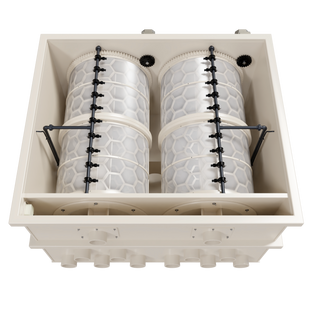
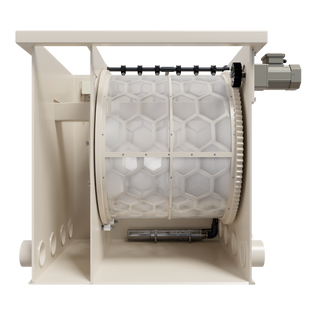
A drum filter uses a rotating drum fitted with a precision filter screen. Water flows through the screen, and mechanical impurities remain on its surface. As the level of contamination increases, an automatic rinsing cycle is triggered. Sediments, suspended matter, organic debris, fish waste and fine solid particles are removed from the circulation.
The most important thing is that dirt does not accumulate inside the filter for days on end. In conventional systems, contaminants are trapped in sponges or filter cartridges, where they can restrict flow and decompose in the water. The drum filter removes them automatically, allowing the entire system to operate more reliably.
Why does a traditional pond filter require frequent cleaning?
A typical pond filter traps debris inside the filter cartridges. Initially, this works well, as the water passes through sponges or mats and larger particles are trapped. The problem arises later, when the amount of debris increases.
Leaves, pollen, algae, food debris and fish waste gradually block the flow. The pump has to work harder, and filtration becomes less effective. The pond owner then has to clean the cartridges more often, rinse the sponges and dismantle the filter. With a larger pond or a larger number of fish, this maintenance can become very tedious.
A drum filter solves this problem in a different way. It does not wait for debris to accumulate inside. It automatically removes it from the surface of the screen, ensuring that the flow remains more stable.
Drum filter or pressure filter?
A pressure filter is a popular choice for small ponds, as it is relatively simple and easy to install. It works well in small ponds with a low load. However, with a larger number of fish, more frequent feeding or a larger pond, its limitations become apparent.
The biggest difference lies in what happens to the debris. A pressure filter usually traps it inside the cartridges. A drum filter removes it from the system during automatic backwashing. This changes the entire way the system operates.
Therefore, when asking ‘drum filter or pressure filter?’, it is worth considering not only the purchase price, but also subsequent maintenance, flow stability and the amount of work required to keep the water clean. In larger garden ponds, fish ponds and koi ponds, a drum filter is a far more advanced and convenient solution.
Which pond filter should you choose?
The choice of filter depends on the volume of the pond, the number of fish, the feeding regime and the desired level of convenience. A small pond without fish has completely different requirements to a densely stocked koi pond. Therefore, it is not advisable to select a filter based solely on water volume.
If there are fish in the pond, the filtration system must cope with a greater amount of debris. In such cases, flow rate alone is not sufficient. It is also important that the filter can effectively remove debris from the water circulation before it begins to decompose.
The CrawTec range includes drum filters for smaller garden ponds, large ornamental ponds, koi ponds and professional RAS systems. This allows you to select a model based on the actual load on the pond, rather than just its capacity.
Filter for a garden pond with fish
A fish pond requires more powerful filtration than a decorative pond without fish. Every time you feed the fish, additional organic matter is introduced. The more fish there are, the faster the filter must remove pollutants.
A drum filter helps to separate suspended matter and solid particles during the first stage of filtration. This allows the biological components of the system to operate under more favourable conditions, and the water remains clear more easily.
Koi pond filter
A koi pond is one of the most demanding types of garden pond. Koi carp are large, heavily fed and produce a significant amount of waste. In such a pond, mechanical filtration is of paramount importance.
A drum filter for a koi pond removes pollutants before they reach the subsequent stages of water treatment. This helps to reduce the load on the biological filtration system and maintain more stable conditions for the fish.
Self-cleaning pond filter
More and more pond owners are looking for solutions such as a self-cleaning pond filter or automatic pond filtration. The reason is simple: pond owners want clean water, but do not want to spend every weekend cleaning sponges and filter cartridges.
A drum filter is just such a solution. Automatic screen rinsing reduces the need for manual maintenance and helps maintain stable filter performance over the long term.
The most common mistakes when setting up filtration for ponds and water features
One of the most common mistakes is choosing a filter based solely on the stated capacity of the pond. In practice, the number of fish, the amount of food, sunlight exposure, the amount of leaves falling into the water and how the entire system operates are also of great importance.
The second mistake is to focus solely on the UV lamp. A UV lamp can help reduce green water, but it does not remove sediment, fish waste or organic debris. Without effective mechanical filtration, the problem of contamination remains within the system.
The third mistake is thinking about ease of use too late. A cheap filter may seem like a good choice at first, but if it requires frequent cleaning, by the end of the season the user will start looking for a better solution.
A drum filter helps to avoid many of these problems, as it removes debris automatically and provides a solid foundation for the entire filtration system.
Drum filters for RAS systems
Drum technology is not only used in garden ponds and koi ponds. Drum filters are also a key component of professional RAS systems – that is, recirculating aquaculture systems – and closed-loop fish farming.
In such installations, the effective separation of mechanical contaminants from the main circulation is crucial for the stability of the entire system. The drum filter helps to protect subsequent filtration stages and reduce the load on the biological filtration system.
Why choose CrawTec drum filters?
CrawTec drum filters have been designed for users who expect effective, stable and convenient filtration. The range includes models from 15 to 200 m³, allowing you to select a unit suitable for everything from a small garden pond to a large koi pond or a RAS system.
These solutions are for those who wish to move away from the constant cleaning of traditional filters and build a modern filtration system based on automatic debris removal.
Key advantages of CrawTec drum filters
- automatic rinsing of the filter screen,
- effective removal of mechanical impurities,
- more stable water flow,
- less manual cleaning,
- models for garden ponds, koi ponds and RAS systems,
- range of models from 15 to 200 m³,
- modern drum filtration technology,
- convenient operation throughout the season.
FAQ
Which filter should I choose for my garden pond?
For a garden pond with fish, it is worth choosing a filter that effectively removes mechanical impurities. For larger ponds, a drum filter is a very good solution.
Is a drum filter suitable for a garden pond?
Yes. Drum filters can be used in garden ponds as well as in larger ornamental ponds and koi ponds.
How does a drum filter differ from a pressure filter?
A pressure filter usually traps debris inside the cartridges. A drum filter removes it from the system during automatic backwashing.
Is a drum filter self-cleaning?
Yes. A drum filter automatically rinses the filter screen and removes accumulated debris from the system.
Which filter should I choose for a koi pond?
A koi pond requires efficient mechanical filtration. A drum filter is one of the best solutions, as it quickly removes debris from the water circulation.
Does a UV lamp replace a mechanical filter?
No. A UV lamp can help with green water, but it does not remove leaves, fish waste, uneaten food or mechanical debris.
Are drum filters suitable for RAS systems?
Yes. Drum filters are used in RAS systems and closed-loop fish farming as the first stage of effective mechanical filtration.